🎯 Overview
You already have a running agent - an AI worker that follows your written rules and uses your files. The Betty Blueprint (free) gives you Part 5. That part covers the daily schedule and the morning digest. It also covers the quick cheap check we call the lean poller, and the skill template. It ends with a first build weekend, and reports that arrive before you start work. If you built it, you have a worker with a job description.
This course is for the owner who wants to own the machinery underneath. That machinery is the engine - the thing that runs your AI agent day to day. (The technical name, which you'll see on the diagrams, is the "runtime.") "It works" is not enough here. You will know why it works, and what it costs per job. You will know what happens when two agents want the same file, and what to check first at 2am.
📌 The rule of this course: own the layer underneath. Know why it works, what it costs per job, and what you would check first at 2am.
🧩 How it fits together: what this course adds to the free build
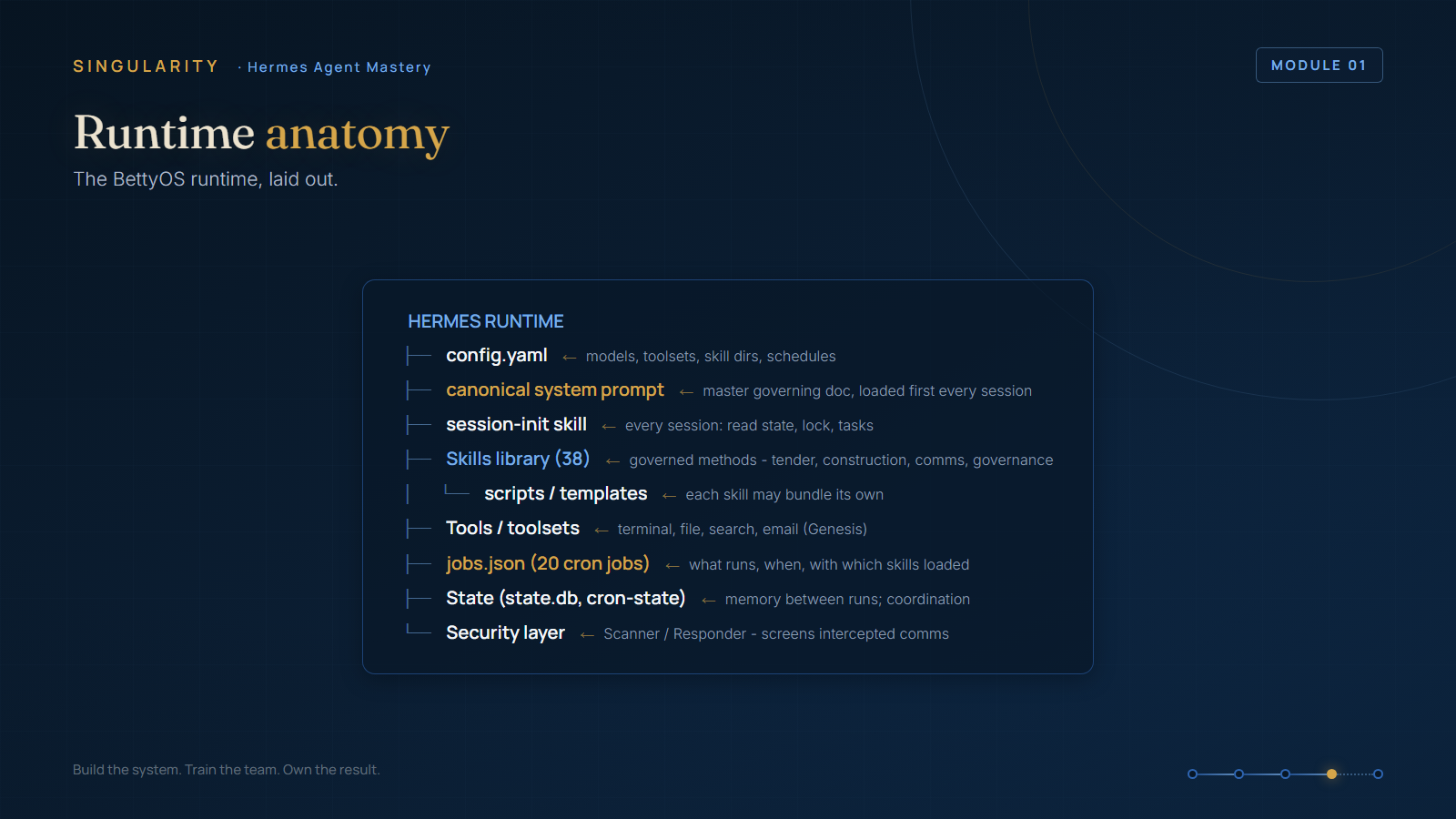
Here is the machine you will be able to draw, part by part, by the end of Module 01:
The five modules:
- Inside the engine (Module 01). What a working agent looks like on disk. Who the agent is, its settings, its jobs on timers, and its written methods. Also what it remembers between runs, and the record of any helpers it starts. The Blueprint shows the schedule; this module shows the machine. It includes a design fact most people miss: half of a real settings file is limits. Guardrails, approvals, approved lists, security.
- Skills and tools in depth (Module 02). A skill is a written method for one repeatable job, done the same way every time. This module shows the method written once, in one official home. Every agent that needs the method finds it there and uses it. You also learn where the agent's personality ends and the method begins.
- Putting jobs on timers (Module 03). The computer can run a job automatically on a schedule, like an alarm clock. The technical name is a "cron job". This module goes past the starter schedule. You learn which jobs need a check every five minutes, and which need one check a day. You also learn how the lean poller - that quick cheap check - keeps an all-day watcher cheap. Each check costs a fraction of a cent.
- Several AI workers, one set of rules (Module 04). The AI tool you use is only the interface - the intelligence does not live there. One system runs many agents. It hands work down, steps problems up, and records who started what. It also sets the boundaries that stop agents from interfering with each other.
- What it remembers, writes down, and costs (Module 05). The written record you can go back and check - the audit trail - is a real business asset. This record-keeping let us find three jobs that used 62% of all spend. You build the weekly efficiency report. Cost per useful run becomes the number that matters.
🧭 Context (what is around it)
The engine you master here already has its next home in Eden Core, our structured business platform. There, an agent holds a real identity with granted permissions. It gets defined tasks with a full paper trail. Its written record is searchable like a register - not a folder full of log files. Betty runs there today as a worker with rules and permissions attached. This course ends with the split: what the engine owns forever, and what the platform takes over.
✅ What good looks like: one promise
Work gets handled overnight without your supervision. When anyone asks what the agent did and what it cost, you answer from the record, not from a guess.