🎯 Overview
Download the full build manual (PDF, 29 pages): your welcome email has the link, or download it at www.onapage.net/blueprint/thank-you.html
Welcome. This lesson is the map to everything we teach here. The PDF is the full build manual that goes with it.
📌 The rule of this lesson: write the rules first. Set up the engine second. Start the AI third. You will hear this said as "governance first, runtime second, agents third". That order is the most important idea in the whole course.
\---
🧭 Context (what Betty is)
Betty is an AI worker - an agent. An agent is an AI worker that follows your written rules and uses your files. Betty runs the back office of a real commercial pool construction business. It works from the company's own files.
Each day it reads the email inboxes and a Teams channel. It files tenders and drafts requests for quote to suppliers. It tracks deadlines. It runs the pricing again when new information arrives. It checks contracts against AS4000. It reports to the owner at 6am and at the end of the day.
💰 The headline numbers: 250+ tasks a day, roughly $10 a day to run, and 38 skills. A skill is a written method for one repeatable job, done the same way every time. Betty replaced about two staff positions worth of admin. It has run as the current system since Christmas 2025.
\---
🧠 Why it is built this way
Here is the honest part: ⚠️ AI is the easy bit. The AI model itself is maybe a tenth of what makes Betty work. The other nine tenths is governance - the written rules for how work gets done and who can change the rules.
In practice, governance means four things. The rules are written down where the agent can read them. Each piece of information has one official home, so there are never two different versions. The agent writes a record of everything it does, so you can go back and check. Hard limits set what the agent may read and what it may never send.
\---
🔧 How it works: the five layers
The picture below shows the whole system as five layers. Two labels on the picture need names before you look. The bridge is a small pointer file that tells any AI tool where your real rules live. The runtime is the engine - the part that runs your AI worker each day.
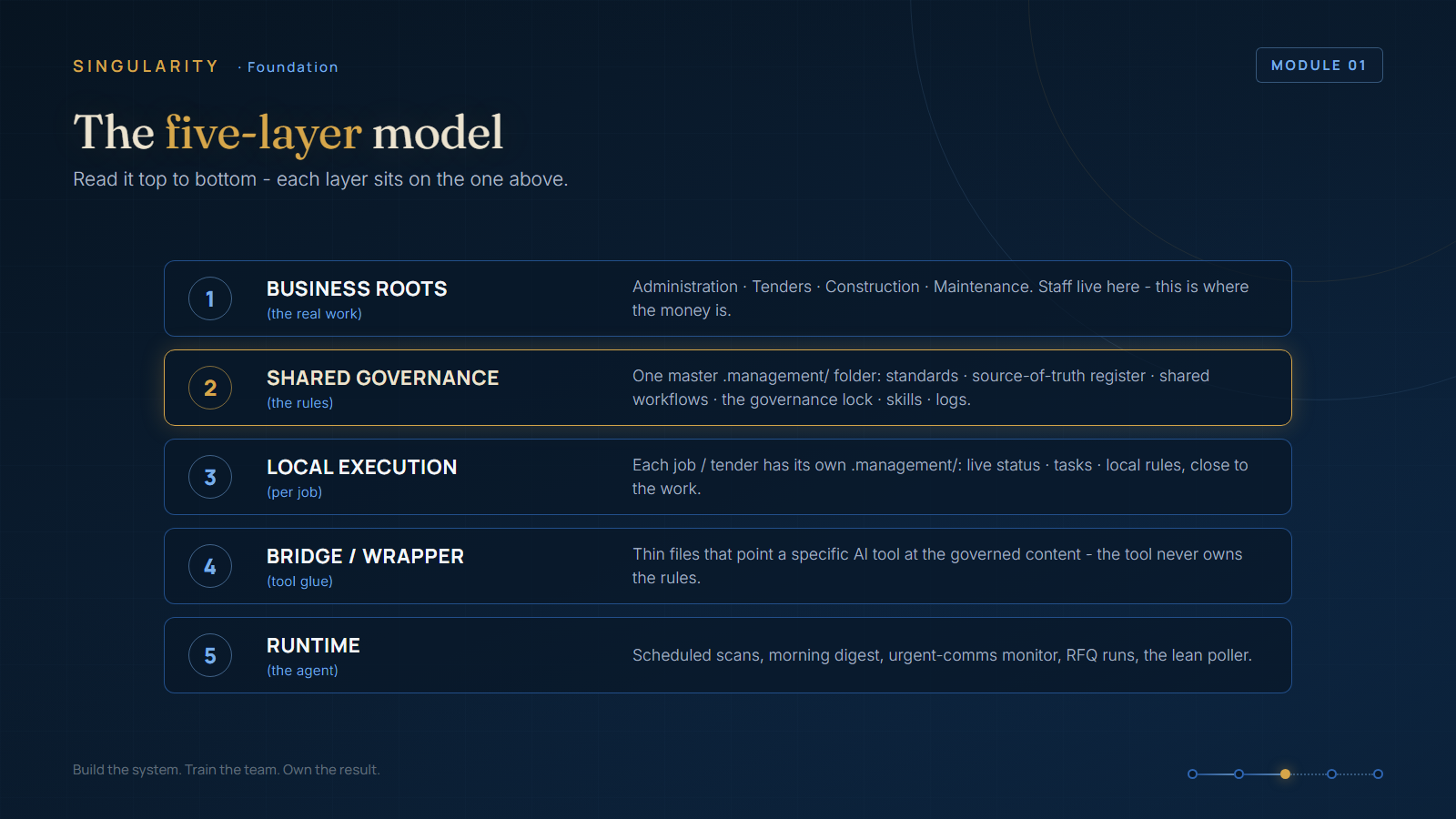
- Business Roots. Your real work - jobs, tenders, suppliers - in normal folders. Staff still work here. Nothing about their day changes.
- Shared Governance. One hidden folder holds all the rules. It holds your standards and a register. The register names the one official home for each piece of information. The folder also holds the governance lock, the skills, and the logs. The governance lock is the short list of things the agent may never change on its own.
- Local Execution. Each job or tender has its own small rules folder. The agent then knows the local ground rules wherever it works.
- The Bridge. The small pointer files aim any AI tool at your rules and your official records. They are small connector files, nothing more.
- The Runtime. The engine itself. It runs scans on a schedule through the day. It makes a morning report. It watches for urgent messages. It also makes a quick, cheap check on a timer. Later diagrams label that check the "poller".
Rules first, engine second, AI workers third - governance first, runtime second, agents third. That order is the base of everything Singularity teaches.
\---
🧩 How it fits together: the PDF, the courses, and where this goes
What the PDF gives you (all of it free). The download is not a sample. It is the build manual. It has the real rules-folder tree. It has the full SSOT Register and Governance Lock templates. The register names the one official home for each piece of information. The lock lists the things the agent may never touch.
The PDF also has a ten-question interview. You give the interview to your agent tool, and the tool writes your rules layer for you. The PDF has the bridge file pattern and a real morning report from the live system. It has the authority rules from the live email skill: exactly what it may read and what it may never send. It has the template for writing a skill of your own. It has the daily schedule with its ten-dollar economics.
Every exhibit is a real document from the live system, with the names made general. Build it in order, and you get a working first version.
What it honestly does not give you. The build is free. To keep it healthy under real pressure is the craft. The PDF does not teach drift - when the real system slowly moves away from how it is supposed to run. It does not teach the sabotage rule. It does not teach how to stop cost blowouts (💰 three of our jobs-on-a-timer - "cron jobs" on the diagrams - once used 62% of all spend before we found it).
It also does not teach security (due to the nature of the internet these days, giving out security info is locked behind in the full course). It does not teach how several AI workers cooperate without conflict. And it does not hold the full library of logged failures and the rules that came from them. The courses cover those topics. The PDF tells you exactly which course covers which gap. If you build the blueprint and never buy a course, we count that as a win.
Where this goes. Everything here runs on normal folders and plain text files today. The next step is Eden Core, our structured business platform. Eden Core uses the same rules-first thinking, with a stronger structure. In it, contacts, tasks, roles, and agent permissions live in one system with a full written record. Betty is already connected to it. This community will see it first.
\---